

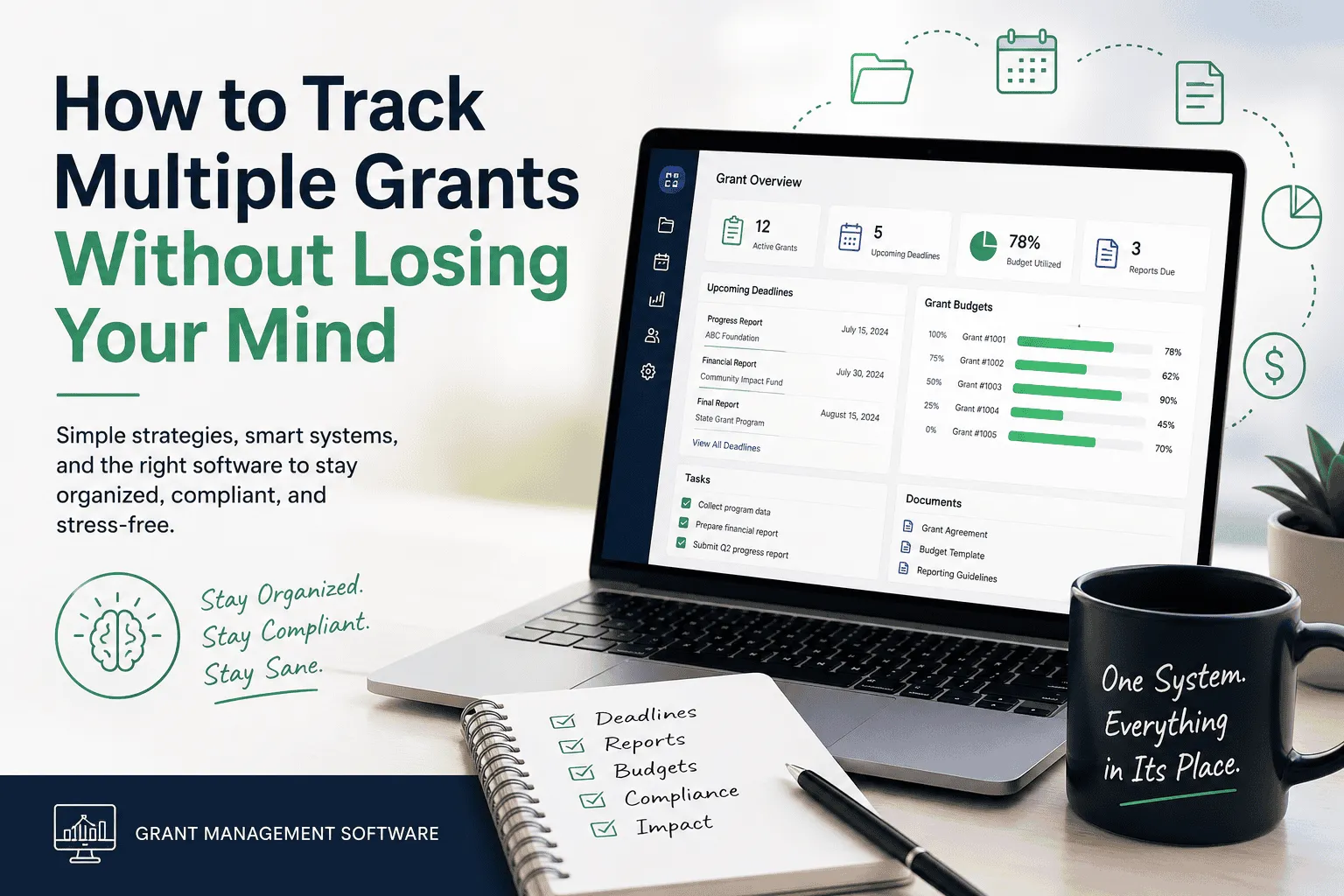
Managing one grant is straightforward. Managing five, ten, or twenty at once is a different challenge entirely. Each award has its own deadlines, its own rules, and its own budget, and the complexity compounds quickly.
When that complexity outpaces your systems, the result is missed deadlines, scattered documents, and reporting chaos. The good news is that a handful of consistent workflows can bring order to even a large grant portfolio. Here are ten strategies that work.
Why tracking multiple grants is so challenging
Before the solutions, it helps to name what makes this hard. Each grant brings:
- Different deadlines and reporting schedules
- Unique compliance requirements
- Separate budgets that must be tracked individually
- Distinct funder expectations and preferences
Multiply those differences across a full portfolio and it becomes clear why spreadsheets alone tend to break down. The work is not just additive; it compounds. Every new grant adds not only its own deadlines and budget but also the mental overhead of keeping it separate from every other grant in your portfolio.
1. Centralize everything in one system
Scattered information is the root cause of most grant tracking problems. Bring awards, deadlines, budgets, documents, and contacts into a single system so your team works from one source of truth instead of hunting across folders and inboxes.
2. Build a clear grant tracking framework
Standardize the information you track for every grant. A consistent framework typically covers:
- Grant overview details, such as funder, amount, and period
- Milestones and deadlines
- Financial tracking against the budget
- Deliverables and their status
When every grant follows the same structure, nothing gets overlooked.
3. Automate deadline tracking
Manual reminders are easy to forget. Set automated alerts at meaningful intervals, for example 30 days, 7 days, and 1 day before a deadline, so the right person gets nudged in time to act.
4. Standardize your reporting process
Create reusable templates and a repeatable workflow for reports. Standardization reduces errors, speeds up preparation, and makes it easier to hand off reporting when staff change.
5. Assign clear roles
Ambiguity about ownership is where grants slip. Assign a responsible person for each grant and for each major task, so accountability is never in question.
6. Track budgets in real time
Reconciling budgets only at report time invites surprises. Track spending against each grant budget continuously, ideally with your accounting system feeding the data, so overspending and underspending surface early. When restricted dollars are involved, strong fund accounting keeps each grant’s funds properly segregated so you never accidentally spend one grant’s money on another’s work.
7. Maintain strong documentation
Keep award letters, agreements, correspondence, receipts, and reports organized and accessible. Good documentation is your defense in an audit and your memory when staff turn over.
8. Use dashboards for a high-level view
A dashboard gives leadership and program staff a quick read on portfolio health, upcoming deadlines, and budget status without digging into individual records.
9. Reduce manual work with automation
Repetitive tasks like data entry, reminders, and status updates are where errors and burnout creep in. Purpose-built grant management software automates much of this so your team can focus on programs and relationships.
10. Regularly review and improve
Set a recurring time to review what is working and what is not. Small adjustments to your framework and workflows keep the system effective as your portfolio grows.
Bringing it together
Tracking multiple grants does not have to mean constant stress. With a centralized system, a clear framework, and automation handling the repetitive parts, you can stay organized, compliant, and confident even as your funding grows.
If you want to see these strategies in action within a connected platform, you can request a demo and explore it with your own portfolio in mind.