

Winning a grant feels like the finish line, but it is really the starting gun. What happens after the award determines whether you deliver on your promises, stay compliant, and earn the next round of funding.
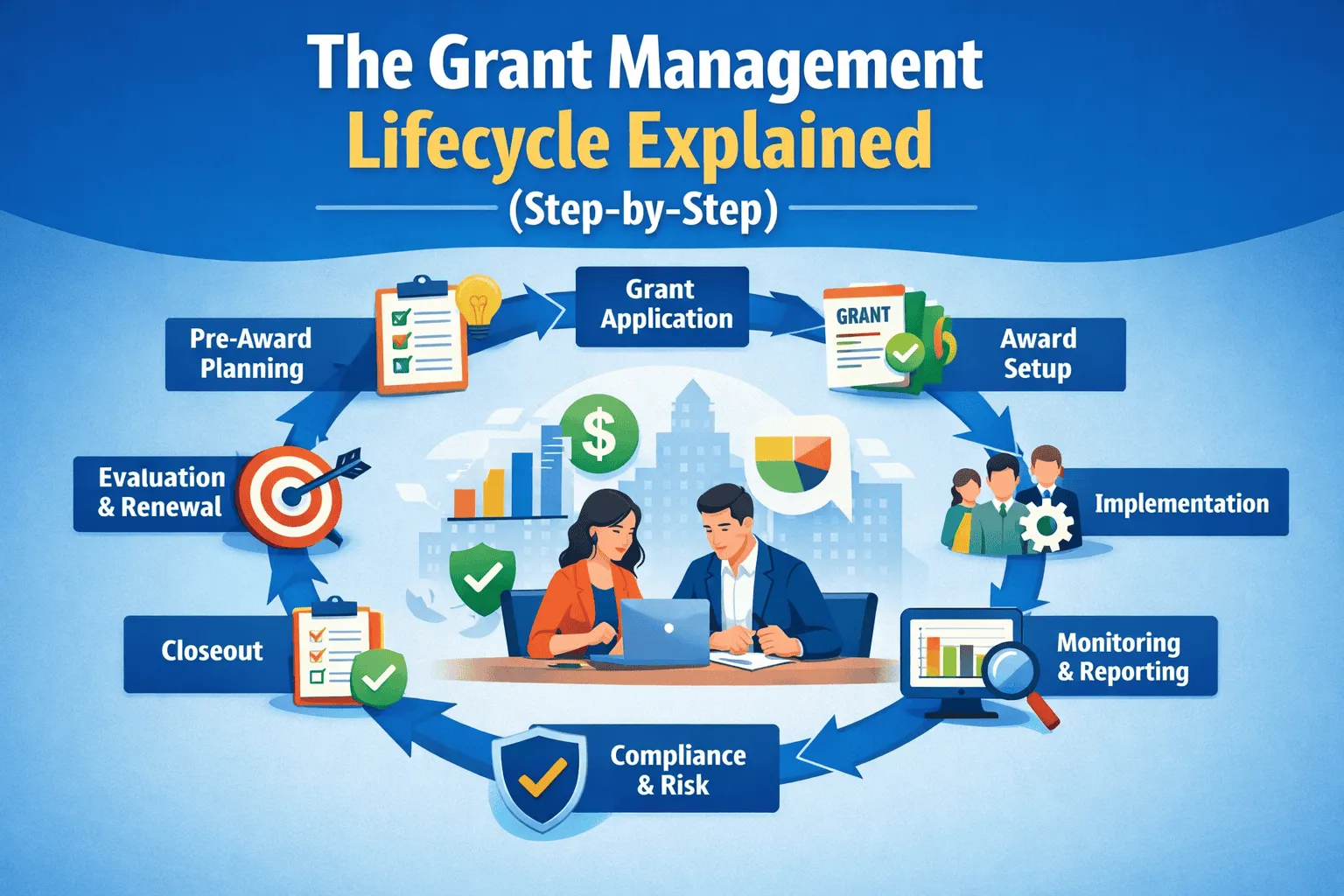
The grant management lifecycle gives you a map for that work. This guide walks through all eight stages, from early planning to renewal, and the common breakdowns to watch for along the way.
What is the grant management lifecycle?
The grant management lifecycle is the full sequence of activities involved in pursuing, managing, and closing out a grant. For federal awards, it aligns with the Uniform Guidance under 2 CFR 200, which sets consistent expectations across agencies. Even for non-federal grants, the same structure brings discipline and clarity.
Thinking in terms of a lifecycle, rather than a series of disconnected tasks, changes how a team operates. Each stage sets up the next: thorough pre-award planning makes the application stronger, careful internal setup makes monitoring easier, and disciplined monitoring makes closeout almost routine.
Step 1: Pre-award planning
Before you write a word of a proposal, lay the groundwork. Key activities include:
- Conducting a needs assessment to clarify the problem you will address
- Identifying funding opportunities that fit your mission
- Confirming eligibility requirements
- Drafting a preliminary budget
- Assigning roles for the pursuit
Step 2: Application and submission
With a target identified, you build and submit the proposal. This stage involves:
- Writing the program narrative
- Developing a detailed line-item budget
- Gathering letters of support
- Submitting before the deadline, ideally with time to spare
Step 3: Award review and internal setup
An award is not the end of paperwork. Before spending begins, you:
- Review the grant agreement and its terms
- Set up accounting codes for the award
- Establish project tracking
- Hold a kickoff to align the team
This setup work prevents compliance problems later.
Step 4: Post-award implementation
Now the program moves from plan to action. Activities include:
- Hiring and onboarding any grant-funded staff
- Launching program activities
- Tracking expenditures against the budget
- Documenting deliverables as they are completed
Step 5: Monitoring and reporting
Throughout the grant period, you monitor both finances and program results. On the financial side, that means expense tracking, budget-versus-actual analysis, and managing drawdowns. On the programmatic side, it means tracking outcome metrics and providing narrative updates to your funder.
Strong fund accounting keeps these two views aligned so reporting stays accurate.
Step 6: Compliance and risk management
Compliance runs in parallel with everything else. Key responsibilities include:
- Verifying that costs are allowable
- Following procurement standards
- Managing conflicts of interest
- Monitoring subrecipients
- Preparing for a Single Audit where applicable
Step 7: Grant closeout
When the grant period ends, a structured closeout protects you. This stage covers:
- Reconciling expenditures against the budget
- Submitting final financial and program reports
- Completing an equipment inventory where required
- Retaining records, typically for three years under 2 CFR 200
Step 8: Evaluation and renewal strategy
Finally, step back and assess. Evaluate what the grant achieved, document lessons learned, and decide whether to pursue renewal. A well-documented track record strengthens your next application.
Common breakdowns
Even experienced teams stumble in predictable places. Watch for:
- Poor internal communication between program and finance
- Weak documentation that fails in an audit
- Inadequate budget monitoring that leads to surprises
- Reactive compliance that scrambles to fix problems after the fact
Addressing these proactively saves far more effort than fixing them later.
Structure creates sustainability
The organizations that manage grants well are not necessarily the largest or best funded. They are the ones with a clear, repeatable process from planning through renewal. Structure is what makes grant funding sustainable rather than chaotic.
If you want to see how a connected platform supports each stage of this lifecycle, you can request a demo and review it against your own workflow.