

When a crisis emerges—whether a natural disaster, public-health emergency, economic disruption, or geopolitical event—nonprofits become first-line responders for communities experiencing the greatest vulnerability. Their ability to act quickly, distribute resources efficiently, and maintain rigorous accountability determines not only the immediate impact of their work but also their long-term credibility with donors, regulators, and partners.
Over the last decade, technology has fundamentally reshaped how nonprofits prepare for, respond to, and recover from crises. Tools once reserved for federal agencies or large multinational institutions are now accessible to organizations of all sizes, creating new possibilities for situational awareness, coordination, financial management, and data-driven decision-making.
This analysis examines the technologies redefining crisis response—and the operational frameworks nonprofits must develop to ensure transparency, agility, and resilience.
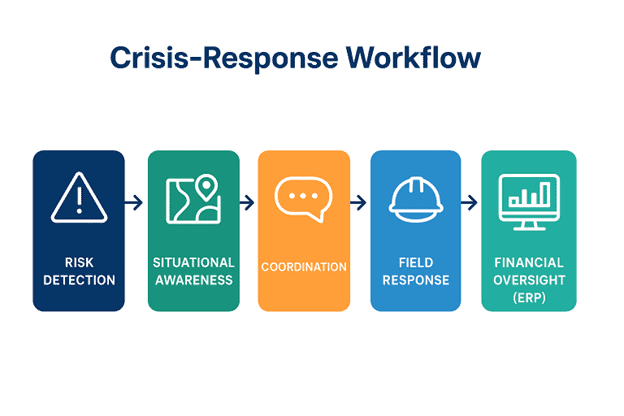
1. Real-Time Crisis Mapping and Situational Awareness
One of the most transformative developments in crisis response has been the adoption of digital crisis-mapping platforms. These systems aggregate information from field workers, public submissions, satellite data, and third-party alerts to provide a live geographic view of evolving conditions.
Modern crisis-mapping tools offer:
- High-resolution location data identifying precisely where needs are emerging
- Crowdsourced inputs for ground-level visibility
- Automated data consolidation from SMS, mobile apps, and external feeds
- Resource-routing intelligence that reduces waste and accelerates impact
With real-time insights, organizations can allocate personnel, supplies, and funding strategically—an essential capability when every minute matters.
2. Digital Coordination Platforms in Disrupted Environments
Crises frequently destabilize conventional communication channels. Power outages, infrastructure disruptions, staff displacement, and remote operations force nonprofits to rely on decentralized, cloud-based collaboration tools.
The most effective platforms provide:
- Distributed workforce coordination
- Scalable volunteer activation and task assignment
- Encrypted messaging for sensitive environments
- Mobile-optimized workflows for field teams in low-connectivity zones
These tools support operational continuity when traditional office-based operations are compromised.
3. Technology-Enabled Mental Health and Crisis Hotlines
As communities experience increased psychological impacts, including trauma, displacement, and uncertainty—digital mental-health response systems have become a core component of nonprofit emergency services.
Key features include:
- Anonymous text-based hotlines
- AI-supported triage models that identify urgent cases
- Automated routing to trained responders
- Low-barrier access for individuals hesitant to call traditional hotlines
These platforms significantly expand the reach of nonprofits offering crisis counseling and emotional support during high-impact events.
4. AI-Assisted Early Warning and Predictive Analysis
Artificial intelligence now plays a major role in crisis prediction and preparedness. AI-powered monitoring systems integrate meteorological data, environmental sensors, public-health indicators, and mobility statistics to forecast risks in advance.
Applications include:
- Flood and wildfire forecasting
- Outbreak detection
- Humanitarian migration modeling
- Risk-zone identification
Predictive insights enable nonprofits to pre-position supplies, generate early-stage budgets, and coordinate with partner agencies before a crisis intensifies.
5. Data Analytics for Evidence-Driven Decisions
Crisis environments generate vast quantities of data—from incident reports and supply levels to transportation metrics and public-sentiment signals. Nonprofits that can rapidly synthesize these inputs gain a strategic advantage.
Analytics support:
- Real-time needs assessment
- Resource-to-need matching
- Staffing and logistics forecasting
- Transparent operational reporting
Data-driven decision-making helps organizations deploy limited resources with maximum precision.

6. The Financial Backbone of Crisis Response: ERP and Nonprofit Accounting Systems
While crisis-mapping and AI often capture headlines, the financial infrastructure underlying crisis response is equally critical. Field operations are only as strong as the systems governing funds, compliance, and financial clarity.
This is where nonprofit ERP systems become indispensable.
Real-Time Budget Visibility
To shift resources quickly, leaders require instant insight into available funds, program expenses, and real-time burn rates. NonProfit+ supports this through advanced budgeting and reporting capabilities that surface financial data the moment it changes.
Dedicated Emergency and Restricted Fund Management
Crisis-related funding—emergency grants, donor-restricted contributions, or public-sector allocations—must be isolated and monitored with absolute precision.
The grant management capabilities within NonProfit+ ensure funds remain compliant with donor intent and regulatory requirements.
Grant Compliance and Audit-Ready Documentation
During periods of accelerated spending, documentation must be organized and audit ready. ERP systems automate approval workflows, maintain digital audit trails, and consolidate records in a single secure environment.
Dimensional Accounting for Multi-Region or Multi-Program Response
Most crises affect multiple regions or service lines simultaneously.
The fund accounting system within NonProfit+ enables organizations to track expenses, activities, and outcomes across programs, locations, departments, and funding sources—all within a unified framework.
Operational Continuity in Disrupted Environments
Cloud-based financial systems ensure uninterrupted access for finance teams, even when offices are inaccessible or staff are dispersed. NonProfit+ supports continuity through its cloud-based nonprofit accounting software, allowing critical financial operations to remain uninterrupted during emergencies.
Rapid Reporting for Stakeholders
Crisis periods increase donor, board, and regulatory reporting demands.
ERP-driven reporting structures help organizations deliver real-time transparency without manual consolidation.
In short, ERP technology forms the financial command center of crisis response—supporting accuracy, stewardship, and organizational resilience under pressure.
7. Ethical and Human-Centered Use of Technology
As nonprofits adopt more advanced digital capabilities, they must maintain strong ethical safeguards.
Key principles include:
- Privacy protection for sensitive data
- Accessibility, including low-bandwidth functionality
- Transparency in AI-assisted analysis
- Equity to ensure underserved populations remain visible in datasets
Effective crisis technology strengthens reach without compromising dignity or security.
8. Lessons for Building Organizational Resilience
The most crisis-ready nonprofits share several operational attributes:
Integrated Systems
Unified infrastructures—where communication tools, analytics platforms, and financial systems operate cohesively—enable speed and clarity during emergencies.
Training and Preparedness
Teams trained on the organization’s technology stack can mobilize rapidly and execute with confidence.
Redundancy and Risk Planning
Backup systems, cloud-based access, remote-ready workflows, and scenario planning protect organizational continuity.
Strategic Technology Partnerships
Strong vendor relationships provide flexibility, rapid support, and sometimes emergency capacity extensions during major events.
Continuous Modernization
Crisis response evolves quickly; nonprofits must reevaluate operational processes regularly and update technology accordingly.
Conclusion: A New Era of Technology-Enabled Crisis Response
Modern crises—environmental, economic, humanitarian, and public-health related—demand a level of operational agility that manual processes cannot support. Crisis-mapping tools, digital coordination platforms, predictive analytics, and AI have expanded what nonprofits can accomplish in chaotic environments.
Yet the foundation of effective crisis response remains clear financial governance, transparent reporting, and operational stability. Nonprofit ERP solutions provide this backbone, enabling organizations to respond quickly while upholding the accountability and stewardship standards essential to their mission.
Technology does not eliminate complexity, but it empowers nonprofits to navigate uncertainty with clarity, structure, and resilience—ensuring they can deliver meaningful impact when communities need them most.
