
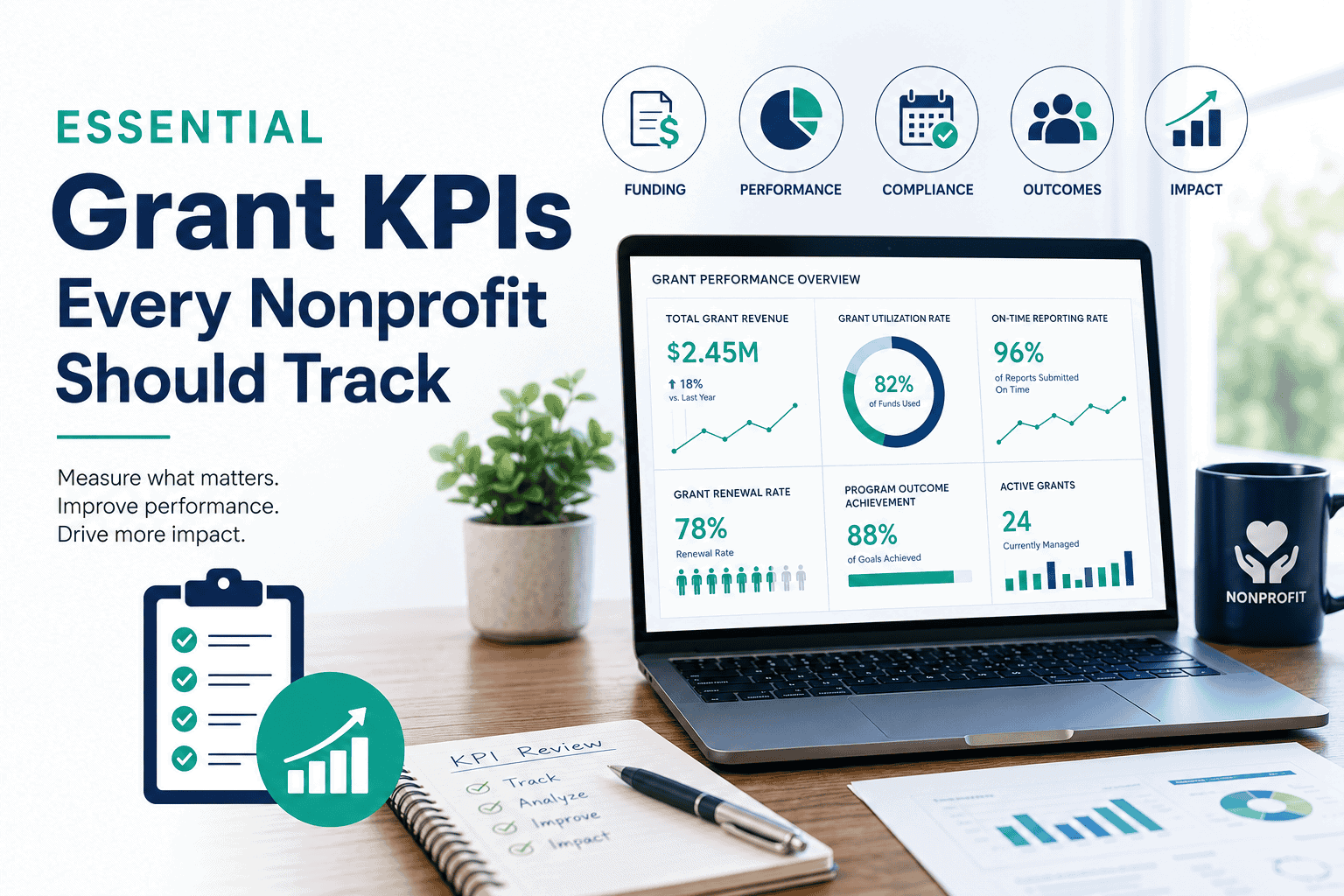
Grant funding is the lifeblood of many nonprofit organizations. Whether you’re managing a handful of grants or overseeing a complex portfolio of government, foundation, and corporate funding sources, success depends on more than securing awards. Effective grant management requires ongoing measurement, analysis, and reporting.
That’s where key performance indicators (KPIs) come in.
Grant KPIs help nonprofit leaders understand how effectively they are managing funding, meeting compliance requirements, delivering programs, and positioning themselves for future funding opportunities. By tracking the right metrics, organizations can make data-driven decisions, improve operational efficiency, and demonstrate impact to funders and stakeholders.
In this guide, we’ll explore the essential grant KPIs every nonprofit should track and explain how these metrics can strengthen your grant management strategy.
Why Grant KPIs Matter
Many nonprofits focus heavily on grant acquisition but spend less time measuring performance after an award is received. Without meaningful metrics, it becomes difficult to identify bottlenecks, evaluate program success, or ensure compliance with grant requirements.
Grant KPIs provide several important benefits:
- Improve visibility into grant-funded programs
- Strengthen compliance and reporting processes
- Help leadership allocate resources effectively
- Demonstrate accountability to funders
- Support future grant applications with data-backed results
- Identify opportunities to increase operational efficiency
When tracked consistently, KPIs transform grant management from a reactive process into a proactive strategy.
1. Grant Application Success Rate
One of the most important fundraising KPIs is your grant application success rate.
Formula:
Applications Awarded ÷ Applications Submitted × 100
This metric measures the percentage of grant proposals that result in funding.
For example, if your organization submits 40 grant applications and receives 12 awards, your success rate is 30%.
Why It Matters
Tracking application success rates helps nonprofits:
- Evaluate the effectiveness of grant writing efforts
- Identify high-performing funding sources
- Improve proposal development strategies
- Forecast future funding opportunities
Organizations should also segment this KPI by funder type, grant size, and program area to uncover deeper insights.
2. Total Grant Revenue
Total grant revenue tracks the amount of funding received during a specified period.
This KPI provides a high-level view of your organization’s grant funding performance and growth over time.
Why It Matters
Monitoring grant revenue helps leadership:
- Measure fundraising effectiveness
- Compare performance year over year
- Assess dependence on grant funding
- Support budgeting and financial planning
Many organizations review this KPI monthly, quarterly, and annually to identify trends.
3. Grant Renewal Rate
Securing new grants is important, but retaining existing funders is often more cost-effective.
Formula:
Renewed Grants ÷ Eligible Renewal Opportunities × 100
Why It Matters
A high renewal rate indicates:
- Strong funder relationships
- Effective program delivery
- Consistent reporting and compliance
- Demonstrated impact
Organizations with strong renewal rates often spend less time pursuing replacement funding and more time expanding programs.
4. Grant Compliance Rate
Compliance is one of the most critical aspects of grant management.
Grant compliance rate measures how consistently your organization meets funder requirements, including:
- Reporting deadlines
- Financial documentation
- Program deliverables
- Audit requirements
- Record retention policies
Why It Matters
Compliance failures can lead to:
- Funding reductions
- Repayment obligations
- Damaged funder relationships
- Loss of future grant opportunities
Many nonprofits track compliance as a percentage of completed requirements versus total requirements.
5. On-Time Reporting Rate
Grant reporting is a major responsibility for nonprofit teams.
Formula:
Reports Submitted On Time ÷ Total Reports Due × 100
Why It Matters
Timely reporting demonstrates professionalism and accountability.
A strong reporting rate helps organizations:
- Build trust with funders
- Reduce compliance risks
- Improve renewal opportunities
- Avoid last-minute administrative burdens
Organizations should aim for near-perfect performance in this area.
6. Funds Utilization Rate
Receiving grant funding is only part of the equation. Organizations must also use funds effectively within grant timelines.
Formula:
Funds Spent ÷ Funds Awarded × 100
Why It Matters
A low utilization rate may indicate:
- Program delays
- Staffing shortages
- Inefficient implementation
An excessively high utilization rate early in the grant period may create budget concerns later.
Tracking utilization helps ensure programs stay aligned with approved budgets and timelines.
7. Cost Per Grant Application
Grant-seeking requires significant investments of time and resources.
Cost per grant application measures the average expense associated with submitting a proposal.
Costs may include:
- Staff salaries
- Consultant fees
- Research expenses
- Software costs
- Administrative support
Why It Matters
Understanding application costs helps nonprofits:
- Evaluate return on investment
- Prioritize high-value opportunities
- Improve resource allocation
- Increase fundraising efficiency
This KPI is especially useful for organizations pursuing a large volume of grants annually.
8. Grant ROI (Return on Investment)
Grant ROI evaluates whether the resources invested in obtaining and managing grants generate meaningful financial returns.
Formula:
(Grant Revenue − Grant Management Costs) ÷ Grant Management Costs × 100
Why It Matters
This metric helps leadership determine:
- Which funding opportunities are most valuable
- Whether grant programs are financially sustainable
- How effectively staff resources are being used
Not all grants deliver equal value. Some may generate significant funding while requiring minimal administrative effort.
9. Program Outcome Achievement Rate
Funders increasingly expect organizations to demonstrate measurable impact.
This KPI measures the percentage of program goals achieved using grant funding.
Examples include:
- Individuals served
- Meals distributed
- Students enrolled
- Housing placements completed
- Job placements secured
Why It Matters
Outcome achievement directly influences:
- Funder satisfaction
- Renewal decisions
- Community impact
- Organizational credibility
Nonprofits should align outcome KPIs with the specific objectives outlined in grant agreements.
10. Average Time to Award
This KPI measures the average duration between application submission and award notification.
Why It Matters
Understanding funding timelines helps organizations:
- Improve cash flow planning
- Manage staffing decisions
- Forecast future funding
- Prioritize opportunities with faster award cycles
Different grant types often have significantly different review periods, making this metric valuable for strategic planning.
11. Active Grants Managed Per Staff Member
As organizations grow, workload management becomes increasingly important.
This KPI tracks the number of active grants assigned to each staff member.
Why It Matters
Monitoring workload helps prevent:
- Staff burnout
- Missed deadlines
- Compliance issues
- Reporting delays
It also provides valuable insights for staffing and resource planning.
12. Funder Retention Rate
Funder retention measures how many grantmakers continue supporting your organization over time.
Why It Matters
Retaining funders often costs less than acquiring new ones.
Strong retention rates indicate:
- Positive relationships
- Effective communication
- Successful program outcomes
- Consistent compliance
Long-term funding partnerships can provide greater financial stability and support organizational growth.
Building a Grant KPI Dashboard
Tracking metrics manually can quickly become overwhelming, especially for organizations managing multiple funding sources.
Many nonprofits create centralized grant KPI dashboards that provide real-time visibility into:
- Awarded funding
- Reporting deadlines
- Compliance status
- Budget utilization
- Program outcomes
- Renewal opportunities
A well-designed dashboard enables leadership, finance teams, development staff, and program managers to access the same information and make informed decisions.
Organizations using grant management software can automate much of this process, reducing administrative work while improving data accuracy.
Best Practices for Grant KPI Tracking
To maximize the value of grant KPIs, nonprofits should follow several best practices:
Define Clear Ownership
Assign responsibility for each KPI to a specific team member or department.
Standardize Data Collection
Use consistent methods for collecting and reporting data across all grant programs.
Review Metrics Regularly
Monthly and quarterly reviews help identify issues before they become major problems.
Focus on Actionable Insights
Avoid tracking metrics simply for the sake of reporting. Every KPI should support better decision-making.
Align KPIs with Strategic Goals
Ensure that your grant metrics support broader organizational objectives, including program growth, financial sustainability, and community impact.
Successful grant management extends far beyond winning funding. Nonprofits must continuously monitor performance, maintain compliance, demonstrate impact, and optimize resources to maximize the value of every grant received.
By tracking essential grant KPIs such as application success rates, compliance performance, reporting timeliness, fund utilization, renewal rates, and program outcomes, organizations can gain deeper visibility into their grant operations and make more informed decisions.
As grant portfolios grow in size and complexity, a strong KPI framework becomes increasingly important. The right metrics not only improve day-to-day grant management but also strengthen funder relationships, support long-term sustainability, and help nonprofits achieve greater mission impact.
Organizations that embrace data-driven grant management are often better positioned to secure future funding, demonstrate accountability, and deliver meaningful results for the communities they serve.
