Managing programs in a nonprofit organization without the right tools can lead to significant challenges. Inefficient data management through spreadsheets or disparate systems makes it difficult to track expenses accurately, measure impact, and allocate resources effectively. This lack of centralized data and transparency can also hinder nonprofits’ ability to adapt programs based on real-time insights, ultimately affecting their mission’s success
Program management software helps nonprofits manage individual initiatives (e.g,
departments, divisions, sub-missions, segments, ministries) in a centralized location
to improve mission impact and performance directly. By centralizing data in one
place, nonprofits can better manage resources, prevent overspending, and provide
clear insights into program performances. This approach enables nonprofits to
demonstrate impact to donors and stakeholders, ensuring funds are used effectively
and strategically.
Every nonprofit has a mission with a vision–a strategy to change the world
effectively. In practice, this mission comprises sub-missions that work together to
accomplish its primary focus through clear and achievable goals.
These sub-missions are the nonprofit’s programs, which are collections of resources
formalized into major services that achieve specific objectives aligned with a
nonprofit’s mission. Programs are essential for nonprofits as they provide structure
and focus, allowing nonprofits to address complex issues systematically.
For example, consider a nonprofit running citywide meal programs with a mission to heal hunger and provide resources for hunger-impoverished populations. They have
a strong mission and vision, but they need a strategy to bring the mission to life
effectively and demonstrate that effectiveness to shareholders with a clear plan and
measurable impact. To accomplish this, they formalize three key programs:
These programs allow the nonprofit to carry out its mission effectively, transparently,
and empirically. By keeping information in one place, they can allocate funds
efficiently and keep stakeholders aware of program progress and value.
In essence, programs are the vehicles through which nonprofits translate their
mission and goals into concrete actions and measurable impact. They are central to a
nonprofit’s ability to create positive change in alignment with its purpose.
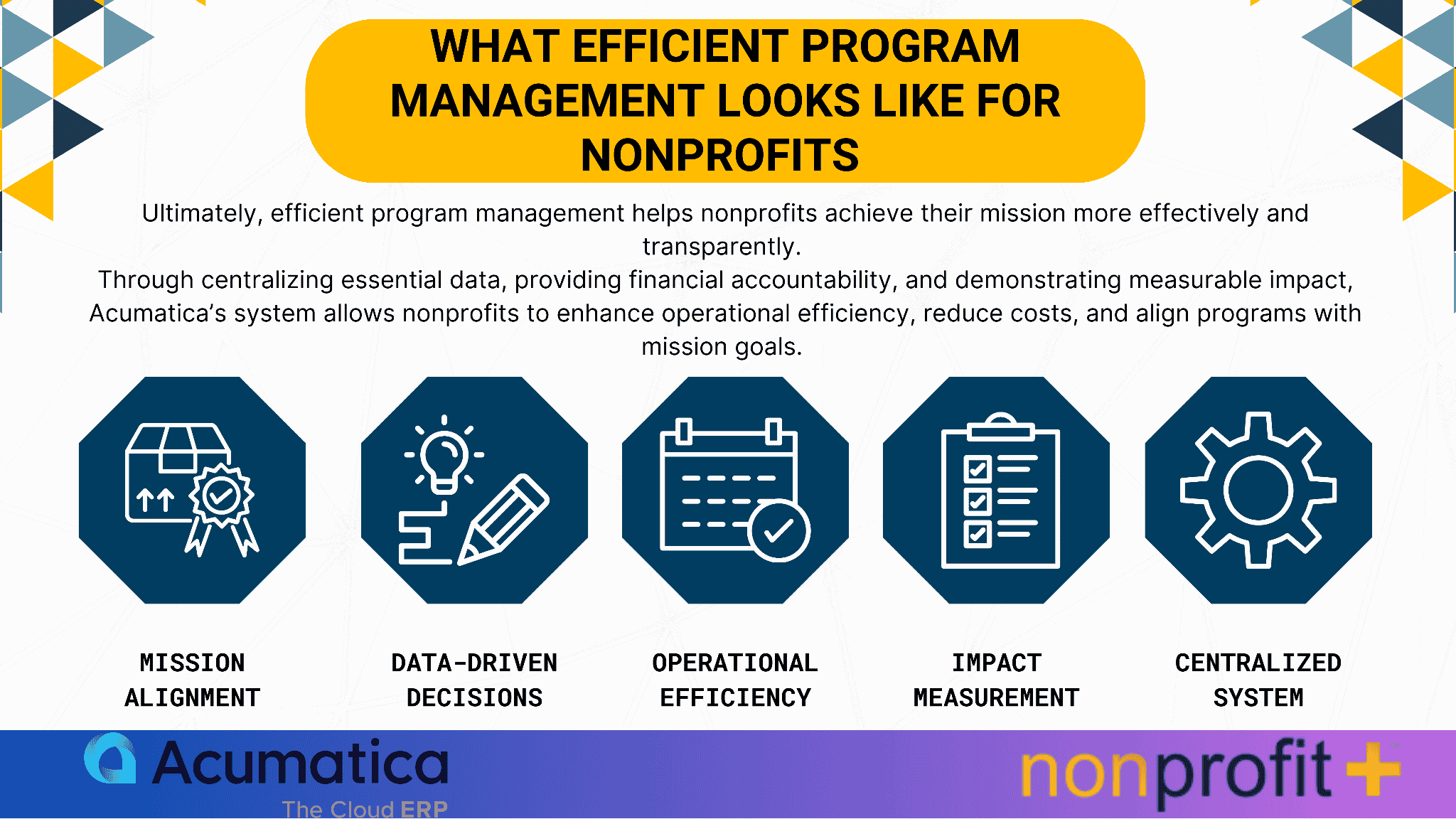
Efficient program management in a nonprofit organization involves a centralized
system where data is controlled, finances are accounted for, and impact is
measurable and transparent. By streamlining these processes, nonprofits can
increase operational efficiency and compliance, reduce costs, and enhance mission
effectiveness.
In a nonprofit, each program must align with the organization’s mission and
values. This alignment requires active stakeholder engagement to ensure
transparency and effective resource use. Program management tools facilitate this
by providing a unified view of all program activities, enabling better communication
and collaboration among team members and stakeholders.
Additionally, program management provides essential data to determine and meet
program goals while allowing data-driven decision-making to track and analyze
progress toward these goals. With accurate and timely data, nonprofits can adjust
their strategies as needed to ensure successful outcomes. Additionally, program
management enables impact measurement, allowing nonprofits to demonstrate
program effectiveness to stakeholders and shareholders, enhancing trust and
transparency.
To illustrate these points, consider two nonprofits that each raise funds for individuals
with lung cancer and aim to increase awareness of and resources for the condition.
Organization A uses an Acumatica-based model for program management. This
system centralizes data, allowing for controlled financial oversight and measurable
impact. With streamlined processes, Organization A can enhance operational
efficacy and compliance, reduce costs, and align programs toward its mission to
support individuals with lung cancer. In this example, they run three major initiatives:
a patient support program, a research funding initiative, and an awareness
campaign.
By utilizing Acumatica, Organization A can track all donations and expenses related
to its initiatives in real-time. For example, when a donor contributes to the patient
support program, the system immediately updates the budget, tracks the allocation
of these funds, and measures the impact on patients’ health outcomes. This
transparency ensures that every dollar is accounted for and used effectively.
Moreover, the organization can generate detailed reports showing how funds are
utilized across different programs. This data-driven approach allows them to adjust
their strategies, such as reallocating funds from the awareness campaign to the
research funding initiative if the data shows a higher impact there. Stakeholders and
donors receive regular updates, showcasing the tangible impact of their
contributions, thus building trust and encouraging continued support.
On the other hand, Organization B also raises funds for individuals with lung cancer
but lacks a formalized program management model. They rely on a mix of
spreadsheets and manual tracking methods to manage their three key initiatives:
direct patient aid, community outreach, and a small-scale research grant program.
Without a centralized system, Organization B faces several challenges. For instance,
when a donor contributes to the direct patient aid program, the staff must manually
update spreadsheets to track this donation. This process is prone to errors and
delays, often leading to confusion about how much money is available and where it’s
going.
When fundraising, Organization B raises significant amounts but struggles to report
how the funds are used. The lack of a unified data management system means they
can’t provide detailed impact reports to donors, leading to dissatisfaction and
decreased repeat donations. Additionally, without accurate, real-time data, the
organization struggles to make informed decisions, such as pivoting resources in
light of a local health crisis, because they lack the visibility to account for this event
and how to allocate resources swiftly.
These examples illustrate the critical limitations of inefficient program management.
That is, program management based on disparate data systems lacks the vision,
control, and real-time reporting that an integrative model offers and is essential for
the modern nonprofit.
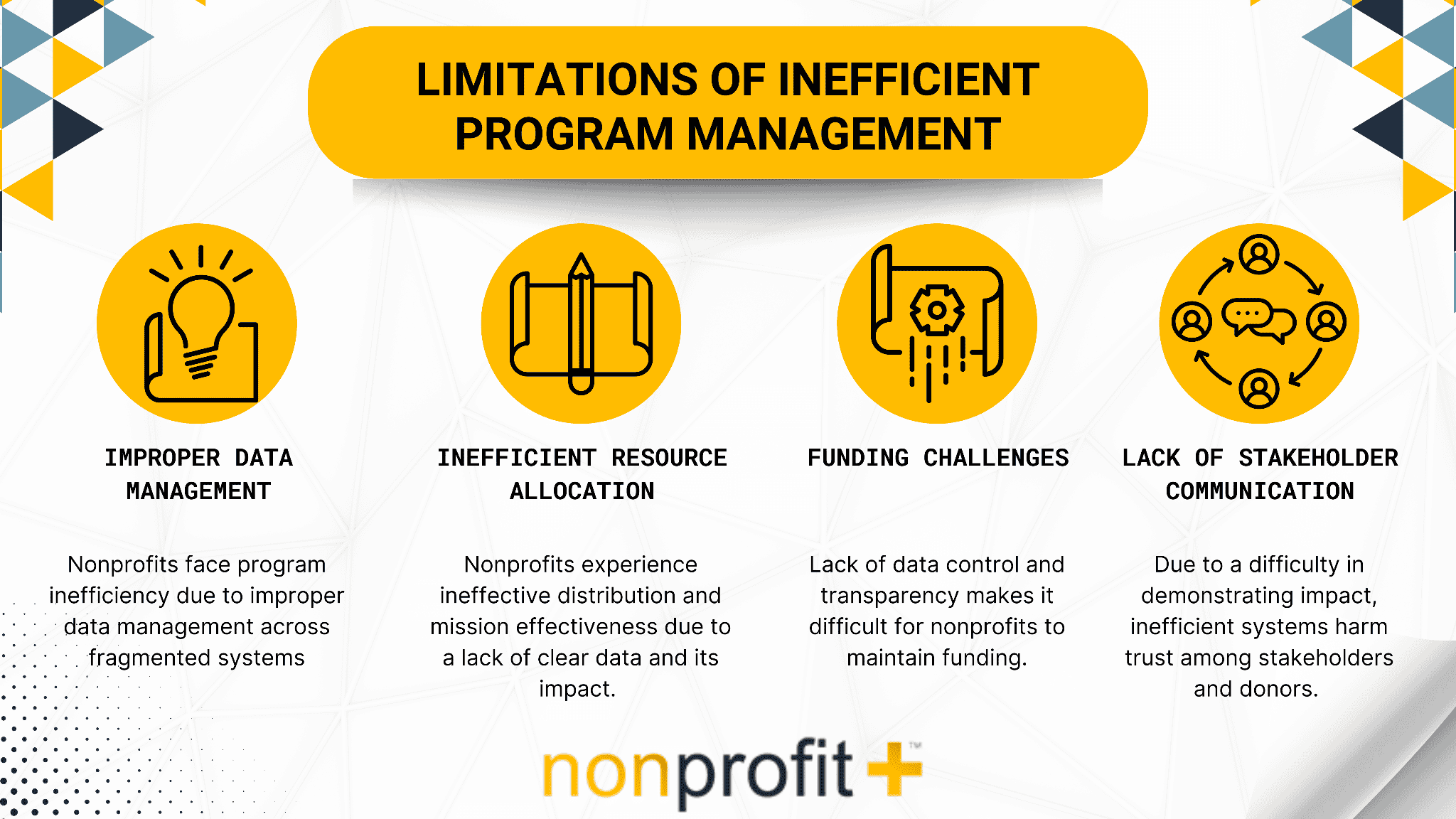
Inefficient program management software creates significant challenges in data
management, resource allocation, and stakeholder communication, limiting your
nonprofit’s operational effectiveness and ability to carry out mission goals
strategically. These issues can severely impact your organization’s ability to deliver
services effectively and measure impact accurately.
When nonprofits cannot demonstrate their effectiveness and the impact of their
programs, it undermines confidence and support, jeopardizing future projects and
initiatives. By addressing these challenges with efficient program management
software, nonprofits can enhance their operational capabilities and build stronger,
more transparent relationships with their stakeholders.
NonProfit+, built on the award-winning Acumatica cloud-based ERP, records all
information needed to perform tasks and activities for each defined program,
resulting in granular tracking of program interactions, expenses, and budgets.
This system provides a centralized platform where your nonprofit enjoys full financial
transparency and operational efficiency. By integrating all program data into a single
source, NonProfit+ ensures that your organization can monitor and manage all
aspects of its operations effectively.
Acumatica is a cloud-based enterprise resource planning (ERP) system that tracks
and automates core business processes to improve performance, adapt to real-time
changes, and streamline operations.
For nonprofits, Acumatica serves as a “single source of truth” for operations, offering
both a vision and practical application for achieving the organization’s mission.
This comprehensive approach enables nonprofits to maintain consistent and
accurate records, facilitating better decision-making and strategic planning
Acumatica’s Nonprofit Accounting Suite provides a comprehensive set of modules
tightly integrated with core financial management, procurement, inventory, expense
management, time entry, and fixed assets functionalities. This tight integration
ensures that all economic activities are coordinated and resources are used
efficiently. The suite allows for real-time tracking of financial transactions,
automated workflows, and detailed reporting, which are crucial for maintaining
compliance and demonstrating impact to stakeholders and donors.
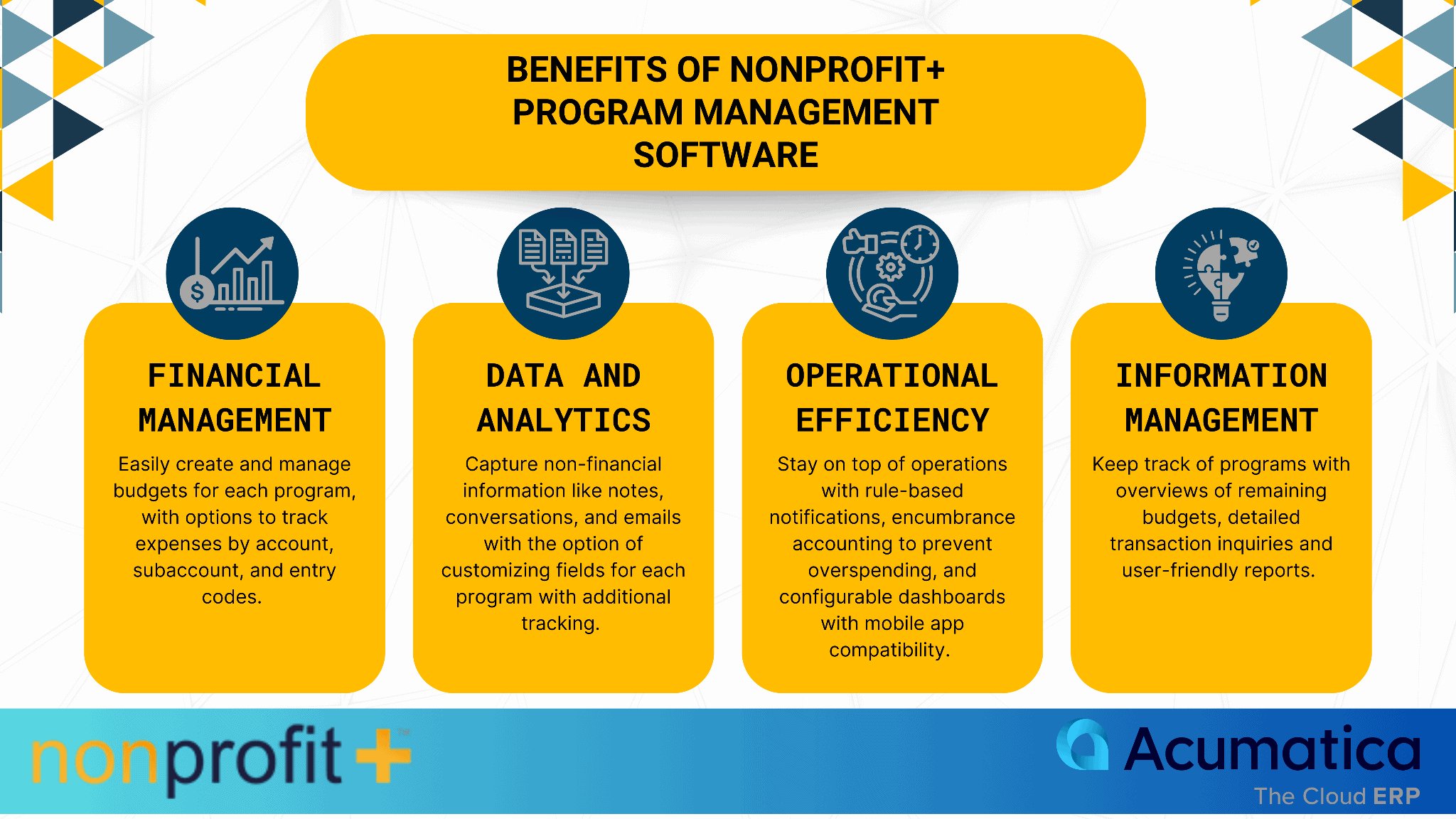
The NonProfit+ system provides a suite of tools that streamline various aspects of
nonprofit program management. These tools enhance efficiency, transparency, and
data-driven decision-making, ultimately supporting the organization’s mission.
Below are the distinct categories of benefits offered by NonProfit+.
In summary, efficient program management is crucial for nonprofits to achieve their
mission effectively. By centralizing data, managing budgets, preventing
overspending, and providing detailed analytics. These features ensure that every
aspect of a nonprofit’s work aligns with its mission, providing measurable and
transparent impact.
NonProfit+, built on Acuamtica’s award-winning ERP software, is dedicated to
helping nonprofits run programs effectively and with your core mission at the
forefront of business operations. Our comprehensive system provides essential tools
that enhance operational efficiency, improve resource allocation, and build stronger
stakeholder relationships. With our software, nonprofits can focus more on their
mission and less on administrative burdens.
NonProfit+ Acumatica software is built on the award-winning Acumatica
cloud-based ERP system. It offers comprehensive features like granular budget
tracking, overspending protection, real-time analytics, and configurable dashboards.
Its integration with core financial management and other modules ensures a holistic
approach to program management.
Yes, NonProfit+ allows for comprehensive configuration and extensive customization
when needed. Users can add custom fields, set up rule-based notifications, and tailor
dashboards to individual preferences. This flexibility ensures that the software can
meet the unique requirements of different nonprofit organizations.
Cloud-based ERP systems like Acumatica provide real-time access to data from
anywhere, facilitate seamless updates and maintenance, and offer robust security
features. This enables nonprofits to stay connected, adapt to changes quickly, and
protect sensitive information.
NonProfit+ offers program access rights, allowing administrators to restrict user
access to specific programs and data. This includes setting permissions for data entry
screens and ensuring that only authorized personnel can view sensitive information,
thereby reducing the risk of data breaches and errors.
Yes, a mobile app is included within our system, ensuring users stay connected and
can manage programs effectively from anywhere, including during essential
fundraisers and business operations.
Nonprofits can get started by contacting NonProfit+ for a consultation. The team will
assess the organization’s needs, provide a demonstration of the software, and guide
them through the implementation process to ensure a smooth transition and
effective use of the system.