
Grant funding can be transformative for nonprofits, universities, healthcare organizations, and public agencies — but winning a grant is only the beginning. The real work begins after the award notification arrives.
Effective grant management ensures your organization stays compliant, meets performance goals, protects funding, and builds long-term funder relationships.
In this guide, we’ll walk through the grant management lifecycle step-by-step, from pre-award planning to closeout and renewal — so you can build a structured, repeatable process.
What Is the Grant Management Lifecycle?
The grant management lifecycle refers to the structured process organizations follow to plan, apply for, administer, monitor, and close out grants.
While terminology varies, most grant professionals follow a framework aligned with best practices and federal guidance such as Uniform Guidance (2 CFR 200).
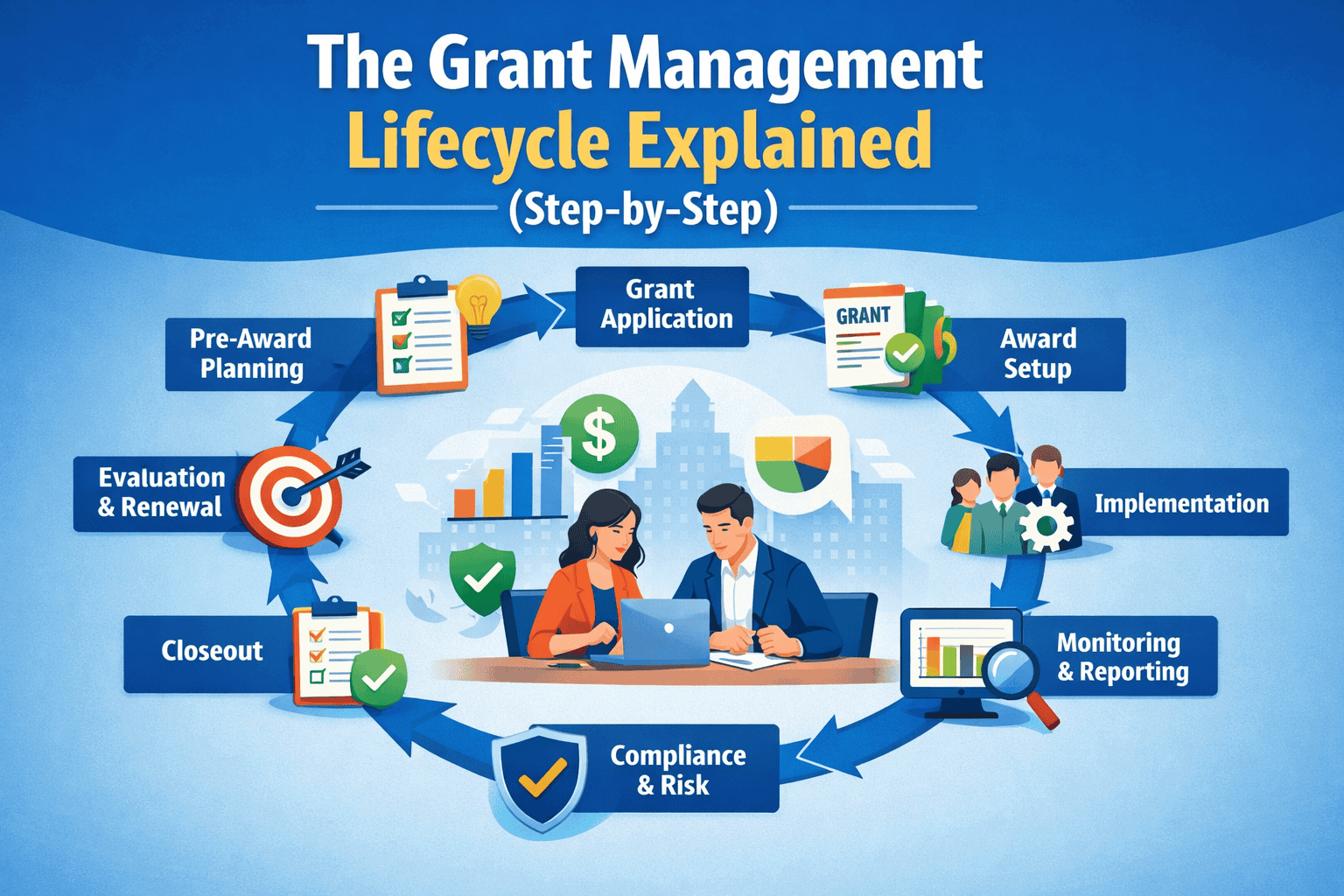
The lifecycle typically includes:
- Pre-Award Planning
- Grant Application & Submission
- Award Review & Setup
- Post-Award Implementation
- Monitoring & Reporting
- Compliance & Risk Management
- Grant Closeout
- Evaluation & Renewal
Let’s break each phase down.
Step 1: Pre-Award Planning
Before submitting any proposal, strategic planning is essential.
Key Activities:
- Conduct a needs assessment
- Identify funding opportunities
- Review eligibility criteria
- Align funding with organizational goals
- Develop a preliminary budget
- Assign internal roles
This phase reduces wasted effort on grants that aren’t a good fit.
Strong pre-award planning includes collaboration between:
- Program staff
- Finance team
- Executive leadership
- Compliance officers
Pro Tip: Build a grant opportunity pipeline tracker to evaluate fit, deadlines, match requirements, and reporting obligations before committing resources.
Step 2: Grant Application & Submission
Once you identify a strong funding opportunity, you move into proposal development.
Key Activities:
- Draft narrative and program design
- Develop a detailed line-item budget
- Secure letters of support
- Review allowable costs
- Submit before deadline
Accuracy matters. Budget errors, inconsistent data, or missing attachments can disqualify otherwise strong proposals.
If applying for federal grants, ensure alignment with compliance standards under U.S. Department of Health & Human Services or other relevant federal agencies.
Many organizations use application checklists to avoid submission mistakes.
Step 3: Award Review & Internal Setup
Congratulations — your grant has been awarded. Now comes internal setup.
This is where many organizations fall behind.
Key Activities:
- Review award agreement thoroughly
- Confirm reporting deadlines
- Finalize budget allocations
- Establish accounting codes
- Set up project tracking systems
- Conduct kickoff meeting with stakeholders
Carefully review:
- Funding restrictions
- Payment schedule
- Match requirements
- Performance benchmarks
- Indirect cost rates
Finance teams should set up unique cost centers in accounting systems to ensure clean tracking from day one.
Step 4: Post-Award Implementation
This is the execution phase — where the program work actually happens.
Key Activities:
- Hire and onboard staff
- Launch services or activities
- Track expenditures
- Document deliverables
- Monitor performance metrics
Strong documentation is critical. Keep organized records of:
- Invoices
- Payroll documentation
- Contracts
- Procurement processes
- Participant data
Failure to document properly can create compliance issues later, especially under federal oversight.
Step 5: Monitoring & Reporting
Monitoring is ongoing throughout the life of the grant.
This phase ensures you are:
- Spending funds correctly
- Meeting objectives
- Submitting reports on time
Financial Reporting
Includes:
- Expense tracking
- Budget vs. actual comparisons
- Drawdown requests
- Indirect cost calculations
Programmatic Reporting
Includes:
- Outcome metrics
- Participant data
- Narrative updates
- Evaluation findings
Federal grant recipients must follow reporting rules aligned with Office of Management and Budget standards.
Late or inaccurate reporting is one of the most common reasons grants are flagged for review.
Step 6: Compliance & Risk Management
Compliance isn’t a single step — it runs parallel to the entire lifecycle.
However, formal risk management should include structured reviews.
Key Areas of Compliance:
- Allowable cost verification
- Procurement standards
- Conflict of interest policies
- Time and effort reporting
- Subrecipient monitoring
- Internal controls
Organizations receiving significant federal funding may also be subject to Single Audit requirements.
Develop a compliance checklist tied to:
- Award terms
- Agency regulations
- Organizational policies
Proactive internal monitoring reduces audit findings later.
Step 7: Grant Closeout
The closeout phase is often underestimated — but it’s critical.
Closeout begins before the project end date.
Key Activities:
- Reconcile all expenditures
- Ensure funds are fully drawn
- Submit final financial reports
- Submit final program report
- Document equipment inventory
- Confirm record retention timelines
Under Uniform Guidance (2 CFR 200), organizations must retain records for a defined period (typically three years after final report submission).
Failure to close properly can delay future funding or trigger repayment requests.
Step 8: Evaluation & Renewal Strategy
The best grant managers treat closeout as the beginning of the next opportunity.
Key Activities:
- Conduct internal debrief
- Analyze program performance
- Document lessons learned
- Assess return on investment
- Identify renewal opportunities
Strong performance data increases renewal likelihood and strengthens relationships with funders.
Even if a grant is not renewable, evaluation insights improve future applications.
Overview of the Grant Lifecycle
Below is a simplified lifecycle framework many organizations follow:
Pre-Award → Application → Award Setup → Implementation → Monitoring → Compliance → Closeout → Evaluation → Renewal
Each stage connects to the next — and weaknesses early in the process often create downstream problems.
Common Breakdowns in the Grant Management Lifecycle
Understanding where organizations struggle can help you avoid pitfalls.
1. Poor Internal Communication
Program and finance teams operating in silos create reporting discrepancies.
2. Weak Documentation
Missing receipts or payroll documentation leads to audit findings.
3. Inadequate Budget Monitoring
Overspending or underspending can jeopardize future awards.
4. Reactive Compliance
Waiting until an audit to organize documentation increases risk.
A proactive, structured lifecycle approach prevents these issues.
Tools That Support the Lifecycle
Many organizations rely on:
- Grant management software
- Accounting systems with grant tracking
- CRM tools
- Shared compliance calendars
- Internal dashboards
Automation improves:
- Deadline tracking
- Budget monitoring
- Reporting accuracy
- Collaboration
Technology isn’t mandatory — but structured systems are.
Why the Grant Management Lifecycle Matters
A well-managed lifecycle helps organizations:
- Protect funding
- Avoid audit findings
- Improve program outcomes
- Build funder trust
- Increase renewal rates
- Strengthen long-term sustainability
Funders increasingly evaluate not just program impact, but administrative capacity.
Strong lifecycle management demonstrates organizational maturity.
Winning a grant is only one milestone in a much larger journey.
The grant management lifecycle — from pre-award planning to evaluation — provides a framework that protects funding, ensures compliance, and maximizes impact.
Organizations that treat grant management as a strategic, structured process (not just paperwork) consistently outperform those that manage reactively.
If your organization hasn’t mapped its grant lifecycle, now is the time to build a documented, repeatable system.
Because in grant management, structure creates sustainability.
