
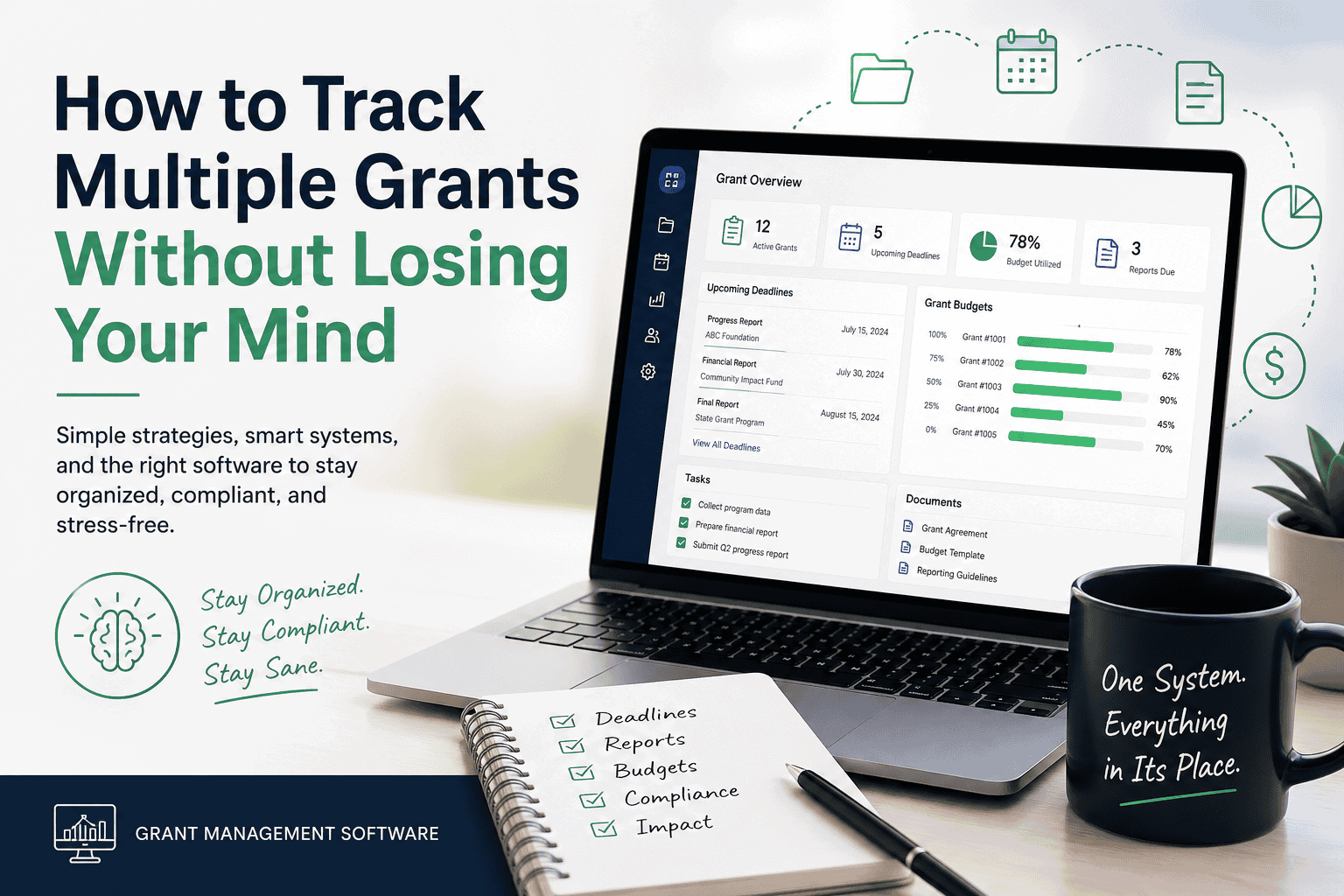
Managing one grant can feel like a full-time job. Managing five, ten, or even twenty at once? That’s where things start to unravel—missed deadlines, scattered documents, and reporting chaos.
The good news: it doesn’t have to be that way. With the right systems—and especially the right grant management software—you can stay organized, compliant, and (relatively) stress-free.
This guide breaks down practical strategies to help you track multiple grants effectively without burning out.
Why Tracking Multiple Grants Is So Challenging
Before jumping into solutions, it’s worth understanding why grant tracking becomes overwhelming in the first place.
Each grant comes with:
- Different deadlines and reporting schedules
- Unique compliance requirements
- Separate budgets and allowable expenses
- Distinct funder expectations
When you’re juggling all of that in spreadsheets, email threads, and sticky notes, things fall through the cracks.
That’s why organizations are increasingly turning to grant tracking software to centralize everything in one place.
1. Centralize Everything in One System
The biggest mistake organizations make is storing grant information across multiple tools.
You might have:
- Budgets in Excel
- Reports in Google Docs
- Deadlines in calendars
- Emails scattered across inboxes
This fragmentation creates confusion and wasted time.
What to do instead:
Adopt a centralized system—ideally a grant management software platform—that allows you to:
- Store all grant documents in one place
- Track deadlines and milestones
- Assign responsibilities
- Monitor budgets in real time
Why it matters:
When everything lives in one system, you eliminate guesswork and reduce the risk of missing critical tasks.
2. Build a Clear Grant Tracking Framework
Even with great software, you need a consistent structure.
A strong grant tracking framework includes:
Grant Overview
- Funder name
- Grant amount
- Start and end dates
- Key contacts
Milestones & Deadlines
- Application deadlines
- Reporting dates
- Renewal timelines
Financial Tracking
- Budget allocation
- Spending to date
- Remaining funds
Deliverables
- Program outcomes
- Reporting requirements
- KPIs or metrics
Most grant tracking software solutions allow you to customize these fields, making it easier to standardize your process across all grants.
3. Automate Deadline Tracking
Deadlines are one of the biggest stressors in grant management.
Missing even one can damage funder relationships—or worse, jeopardize funding.
How to stay on top of deadlines:
- Use automated reminders
- Set recurring notifications for reports
- Create visual timelines (like dashboards or calendars)
Modern grant management software tools often include:
- Built-in alerts
- Email notifications
- Task management features
Pro tip: Set reminders at multiple intervals (e.g., 30 days, 7 days, 1 day before a deadline).
4. Standardize Your Reporting Process
Reporting is where many teams lose time and energy.
Each grant may require slightly different formats, but you can still standardize your internal workflow.
Steps to simplify reporting:
- Create reusable templates
- Define a clear reporting checklist
- Store past reports for reference
- Assign ownership for each report
With grant management software, you can:
- Auto-populate reports with stored data
- Track report status (draft, submitted, approved)
- Maintain a centralized reporting history
This reduces duplication and ensures consistency across submissions.
5. Assign Clear Roles and Responsibilities
When multiple people are involved, confusion can quickly set in.
Who owns the budget?
Who submits reports?
Who communicates with funders?
Without clarity, tasks get delayed—or duplicated.
Best practice:
Define roles for each grant, such as:
- Grant manager
- Finance lead
- Program lead
- Reporting coordinator
Many grant tracking software platforms allow you to assign tasks and permissions, ensuring everyone knows their responsibilities.
6. Track Budgets in Real Time
Financial tracking is one of the most critical—and complex—parts of grant management.
Common issues include:
- Overspending
- Underspending (which can also be a problem)
- Misaligned expense categories
How to improve budget tracking:
- Update expenses regularly (weekly or biweekly)
- Compare actual vs. planned spending
- Flag discrepancies early
With grant management software, you can:
- Integrate financial data
- Generate real-time budget reports
- Ensure compliance with funder requirements
This level of visibility helps prevent surprises at reporting time.
7. Maintain Strong Documentation Practices
Good documentation isn’t just helpful—it’s essential for compliance and audits.
What to document:
- Grant agreements
- Communications with funders
- Financial records
- Program outcomes
- Submitted reports
A centralized grant tracking software system ensures:
- Easy access to documents
- Version control
- Secure storage
This makes audits far less stressful and ensures you’re always prepared.
8. Use Dashboards for a High-Level View
When managing multiple grants, you need both detail and big-picture visibility.
Dashboards provide a quick snapshot of:
- Upcoming deadlines
- Budget status
- Reporting progress
- Overall grant health
Most grant management software tools include customizable dashboards, allowing you to:
- Identify risks early
- Prioritize tasks
- Make informed decisions quickly
9. Reduce Manual Work With Automation
Manual processes are the biggest source of inefficiency.
Automation can save hours every week.
Examples of automation:
- Deadline reminders
- Report generation
- Data entry from integrated systems
- Task assignments
By leveraging grant tracking software, you can:
- Eliminate repetitive tasks
- Reduce human error
- Free up time for strategic work
10. Regularly Review and Improve Your Process
Even the best systems need refinement.
Schedule regular check-ins to:
- Review what’s working
- Identify bottlenecks
- Update workflows
Ask your team:
- Where are we losing time?
- What tasks feel repetitive?
- What could be automated?
Continuous improvement ensures your grant tracking process stays efficient as your organization grows.
Tracking multiple grants doesn’t have to feel overwhelming.
With the right combination of:
- Clear processes
- Defined roles
- Strong documentation
- And powerful grant management software
—you can turn chaos into clarity.
The key is moving away from scattered tools and manual tracking toward a centralized, automated system that supports your team.
When you do that, you’ll not only stay organized—you’ll also improve compliance, strengthen funder relationships, and ultimately increase your impact.
